
ISO 9001 & FDA Compliance for Custom Injection Molded Parts
ISO 9001 & FDA Compliance for Custom Injection Molded Parts
Compliance for a custom injection molded part is verified by two different classes of document, not one. ISO 9001:2015 is a factory-level quality management system certificate. FDA 21 CFR 177.2600 is a material-level food-contact standard demonstrated through laboratory extractives testing. What makes a sourcing file defensible is reading the scope line, the standard, the report number and the validity dates on each document — not whether a supplier uses the word 'certified'.
This guide explains what ISO 9001:2015 and FDA 21 CFR 177.2600 mean for custom plastic injection molded parts, and how documented credentials cover programs shipped to the United States and other global markets. DTG TECH CO., LTD., an injection molding manufacturer based in Xiamen, China, founded in 2002 and exporting 100% of its production to markets including the USA, Europe and India, is used throughout as a worked example together with its Custom Injection Molded Plastic Parts line, model DTG-CIMP-001.
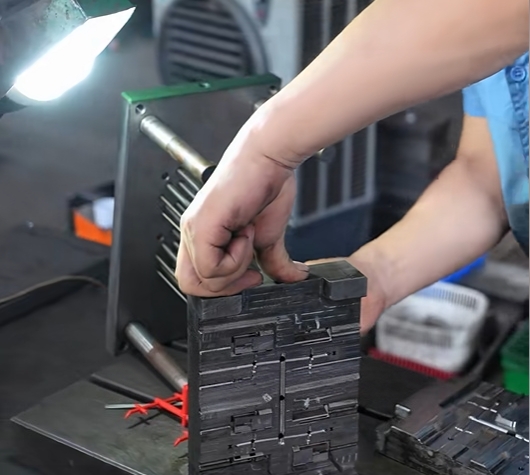
The Compliance Problem: 'Certified' Is Not a Specification
Buyers searching for ISO certified injection molding or FDA compliant plastic parts are usually looking for a single reassurance. In custom molding, no single document provides it. A quality system certificate and a material test report answer different questions, are issued by different bodies and expire on different schedules.
Three failure patterns account for most compliance surprises in custom part sourcing:
- Scope mismatch. The certificate exists, but its declared scope does not cover the process or the product being purchased.
- Material mismatch. The test report is valid, but it was issued for a different resin than the one quoted for the part.
- Document-level mismatch. A factory-level document is treated as product approval, or a supplier's self-declaration is treated as laboratory evidence.
DTG TECH's own documentation shows how precise these documents are. Its ISO 9001:2015 certificate declares a scope of 'the production of injection molds and general injection molded parts' — a bounded statement that covers both tooling and molded part production. Its FDA-related evidence is an SGS test report whose documented scope is total extractives testing for CENUSIL® R 2×0 silicone food contact material. Neither document states that every molded part is food-contact approved, and neither is designed to. Read together with their limits, they show a buyer exactly what has been verified and what still has to be confirmed for a specific part.
Industry Background: Why Documentation Travels With the Part
The scale of the injection molding supply base is why compliance reading has become a routine sourcing task rather than a legal formality. Market Research Future values the global injection molded plastic market at USD 324.98 billion in 2024 and projects it to reach USD 435.74 billion by 2035. China's plastic mold industry is estimated at approximately ¥600 billion, with a projected expansion to ¥1 trillion by 2030, according to JBRplas. An Industry Analysis Report 2025 estimates that China produces roughly 65% of the world's injection-molding machines and accounts for about 60% of global export volume.
For a buyer, the practical consequence is that a custom molded part usually crosses at least one border before it reaches an assembly line. The document package therefore has to satisfy two audiences at once: the destination market's regulator and the buyer's own incoming quality gate.
It also has to sit inside a layered standards landscape. ISO 9001:2015 is a general quality management system standard, not a sector-specific one. Automotive programs typically reference IATF 16949, a specialized quality standard for injection molders serving that sector, emphasizing defect prevention and waste reduction. Medical device molding programs typically reference ISO 13485, which requires specific documentation such as the Device Master Record. ISO 9001:2015 is the base layer beneath both — necessary, but on its own never sufficient for a regulated application.
DTG TECH operates inside that export landscape: a 2,500 m² facility with 80 employees, including a 25-engineer R&D team, producing injection molded plastic parts for the USA, Europe and India. Its compliance documents function as buyer qualification inputs rather than marketing attachments.
What ISO 9001:2015 Actually Certifies
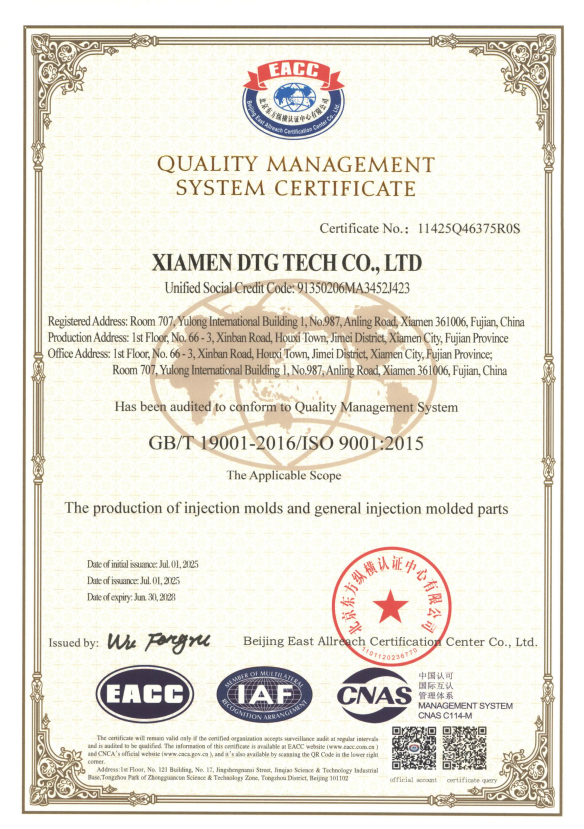
ISO 9001:2015 certification is evidence that a manufacturer's quality management system has been audited against a recognized standard, and that the certified scope has been explicitly defined. In DTG TECH's case the certificate is specific:
- Certificate number: 11425Q46375R0S
- Certification body: Beijing East Allreach Certification Center Co., Ltd. (EACC)
- Standard: GB/T 19001-2016 / ISO 9001:2015
- Certified scope: The production of injection molds and general injection molded parts
- Validity: issued 1 July 2025, valid to 30 June 2028
- Market applicability: Global
What this gives a buyer is process-level assurance. Because the certified scope covers both tooling and molded part production, it applies to programs that combine mold design, tooling and production under one supplier. It also aligns with the inspection sequence documented in production: material confirmation, molding parameter control, dimensional inspection, visual inspection and a final quality check, supported by DFM review, first article inspection and pre-shipment inspection across programs.
What it does not give a buyer is a statement about material safety, food contact, or a regulatory approval in any specific market. Those are separate documents with separate scopes.
What FDA 21 CFR 177.2600 Evidence Means for a Molded Part
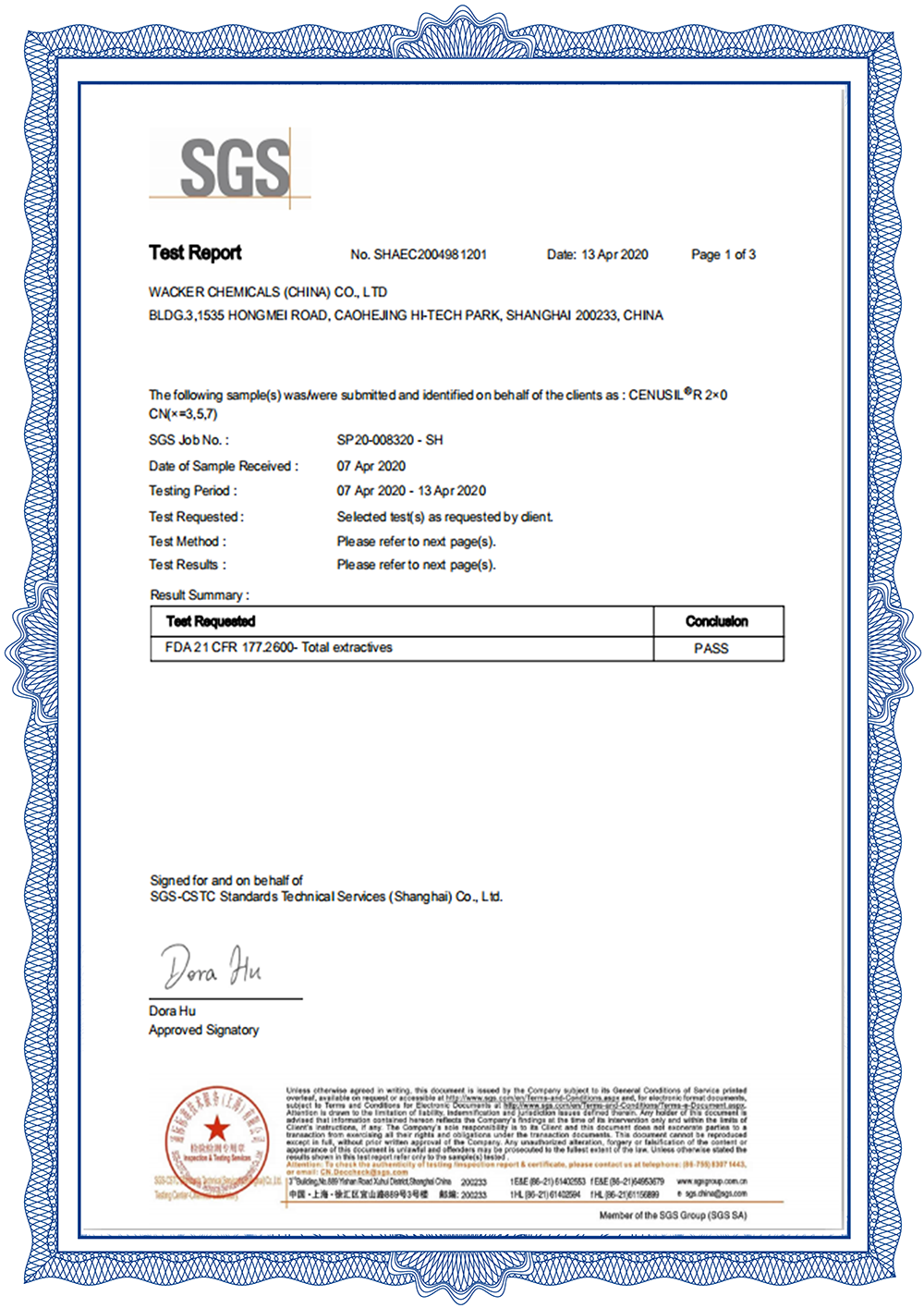
FDA 21 CFR 177.2600 is the regulation that applies to rubber articles intended for repeated use in contact with food, and compliance is demonstrated through extractive testing of the material rather than through a factory audit. DTG TECH's documentation in this area is a laboratory report:
- Report: SGS FDA Food Contact Material Test Report, No. SHAEC2004981201
- Issued by: SGS-CSTC Standards Technical Services (Shanghai) Co., Ltd.
- Standard: FDA 21 CFR 177.2600
- Documented scope: Total extractives testing for CENUSIL® R 2×0 silicone food contact material
- Market: USA
- Issue date: 13 April 2020
The important reading habit here is material matching. The report names the material that was tested. That is normal for food-contact testing, and it means the report transfers to a production part only when the part's food-contact surface uses a material covered by a corresponding test. For a program whose food-contact surface is a molded engineering plastic such as ABS, PP or PC, the correct request to any supplier is extractives test data on the specific grade to be molded — not a general statement of FDA compliance.
For buyers shipping to Europe, the equivalent document class is different. DTG TECH holds an SGS LFGB Food Contact Material Test Report, No. SHAEC2004979701, issued for the German market and tested against the German Food and Feed Code (LFGB) Section 30 & 31 plus BfR Recommendations. Its documented scope covers CENUSIL® 2×0 silicone food contact material, with an issue date of 15 April 2020. A US-market program reads the FDA report; a German-market program reads the LFGB report.
The Supporting Set: Restricted Substances and Third-Party Factory Audit
Two further documents in the same package answer questions that ISO 9001:2015 and food-contact testing do not.
Restricted substances. The SGS EU RoHS Compliance Test Report No. CANEC1103223001 was issued against RoHS Directive 2011/65/EU (EU RoHS II) and 2002/95/EC, with a documented scope of screen printing ink and UV ink substances testing covering lead, mercury, cadmium, hexavalent chromium, PBB and PBDE. Read precisely, this is restricted-substance evidence at the printing and ink level — relevant to decorated or printed parts, and a reminder that in molded components compliance is often verified step by step rather than in a single certificate.
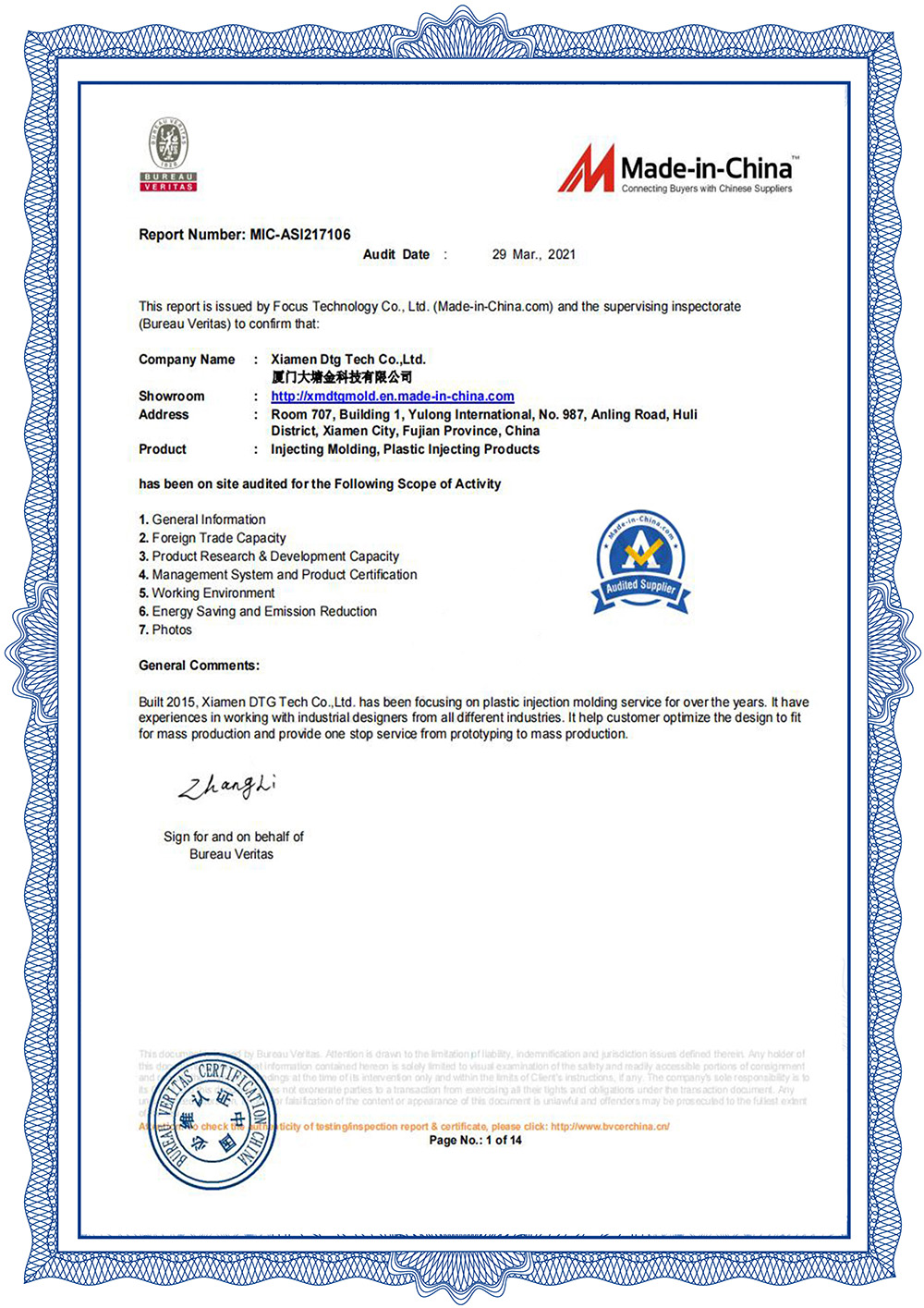
Factory-level third-party verification. The Made-in-China Supplier On-site Audit Report, certificate number MIC-ASI217106, was issued by Bureau Veritas on 29 March 2021, with a scope covering injection molding and plastic injection products and global market applicability. An on-site audit answers a question that self-declarations cannot: whether the production environment, processes and records behind a certificate exist as described.
Case Study: Mapping Compliance to Custom Injection Molded Plastic Parts (DTG-CIMP-001)
The product line used in this guide is documented as follows:
- Product: Custom Injection Molded Plastic Parts, model DTG-CIMP-001
- Type: custom plastic parts, OEM injection molded components, mass production plastic parts
- Process: plastic injection molding
- Part size: customized according to customer design
- Production volume: prototype to mass production
- Tolerance: according to customer drawings and specifications
- Surface finish: texture, polishing, painting, printing available
- Materials: ABS, PP, PC, PC+ABS, TPE, Acrylic and other engineering plastics
- Applicable industries: electronics, automotive, consumer goods, industrial equipment, medical products
Against that product definition, the compliance documents map as follows. The ISO 9001:2015 certificate covers the production of injection molds and general injection molded parts, which is the process category this product line belongs to. The RoHS report addresses restricted substances at the printing and ink level, which is where decoration risk concentrates for custom parts with printing. The Bureau Veritas audit covers injection molding and plastic injection products at the factory level. Food-contact evidence exists in two market-specific versions, and both name the tested material in their scope.
Reading rule for buyers: first identify which document class the application requires, then check that the document's scope names your process, your material and your destination market. For a food-contact program in a specific resin, the productive question is 'do you have extractives test data on the grade we will mold?' rather than 'are you FDA compliant?'
Step-by-Step Breakdown: A Six-Step Compliance Verification Workflow
- Classify the part by regulatory exposure. General industrial and consumer parts typically need system-level and restricted-substance evidence. Food-contact parts need material-level extractives testing for the specific grade. Automotive and medical programs carry sector-specific standards — IATF 16949 and ISO 13485 respectively — on top of ISO 9001:2015.
- Read the scope line of the ISO 9001:2015 certificate. For DTG TECH, the declared scope is the production of injection molds and general injection molded parts, certified by EACC under GB/T 19001-2016 / ISO 9001:2015, and valid from 1 July 2025 to 30 June 2028. If your part is a molded part produced under that scope, the certificate applies; if your process falls outside it, it does not.
- Match material-level reports to the resin and the market. FDA 21 CFR 177.2600 evidence (report No. SHAEC2004981201) applies to the US market; LFGB evidence (report No. SHAEC2004979701) applies to the German market; RoHS evidence (report No. CANEC1103223001) addresses restricted substances in printing inks. Each document has a scope that should name the material or the process step in question.
- Verify document identity. Record the certificate or report number, the issuing body, the standard cited and the issue and expiry dates before the documents enter a supplier file. The five verification anchors in this package are 11425Q46375R0S (ISO 9001:2015), SHAEC2004981201 (FDA 21 CFR 177.2600), SHAEC2004979701 (LFGB), CANEC1103223001 (RoHS) and MIC-ASI217106 (Bureau Veritas on-site audit).
- Validate at the sample stage. Compliance documents describe a capability; samples verify a part. Prototype injection molding runs 7–15 days depending on structure and tooling requirements, and the documented validation sequence covers sample inspection, dimensional checking, functional testing and visual inspection, followed by first article inspection on production.
- Freeze the documents into the purchase order. Acceptance criteria documented for these programs are DFM approval, T1 sample approval, first article inspection and final quality inspection before shipment. MOQ is negotiable based on part size, material, mold requirements and production volume; delivery can be arranged on EXW, FOB or CIF terms by sea or air freight, or through a customer-designated logistics provider; mold projects are documented with a 50% T/T advance to start mold production and a 50% balance after mold approval or before shipment.
Use Cases: Where These Credentials Change a Sourcing Decision
Electronics enclosure programs. A projector housing program produced customized PC+ABS injection molded housings in batches of 30,000–50,000 units, with stable dimensions and appearance quality and a design service life over five years. For decorated housings, restricted-substance evidence at the ink and printing level is the relevant document class, which is where DTG's RoHS test report applies.
Automotive components. An automotive lighting component program used a mold designed for a 500,000-shot production requirement with batch orders of 10,000–50,000 units, ABS flame-resistant material, a complex rib structure and dimensional stability requirements, with a design service life over ten years. Because automotive quality expectations are also expressed through IATF 16949, buyers in this segment typically ask for sector documentation in addition to ISO 9001:2015.
Optical and consumer parts. A lighting manufacturer program delivered 50,000 injection molded optical lenses on schedule in acrylic, meeting high transparency requirements at 98% transparency and passing customer inspection. A consumer product program produced large transparent acrylic molded parts for decorative fountain components with a design service life over five years. A bicycle component program used T1 sample confirmation to resolve surface polishing, gas mark and deformation issues before mass production of a chain protection cover with a design life over three years.
Medical-adjacent programs. DTG-CIMP-001 is documented among others for the medical products industry. Medical device molding programs generally reference ISO 13485, which requires documentation such as the Device Master Record, so buyers in this segment should confirm at quotation stage which additional documents a specific program needs beyond ISO 9001:2015 and material-level testing.
Compliance Document Comparison
The table below summarizes the documented scope of each credential, so that a buyer can match a document class to an application class before requesting anything further.
| Document and number | Type | Standard / directive | Documented scope | Market | Issue date |
|---|---|---|---|---|---|
| 11425Q46375R0S | ISO 9001:2015 certificate (EACC) | GB/T 19001-2016 / ISO 9001:2015 | The production of injection molds and general injection molded parts | Global | 1 July 2025 (valid to 30 June 2028) |
| SHAEC2004981201 | SGS FDA food contact test report | FDA 21 CFR 177.2600 | Total extractives testing for CENUSIL® R 2×0 silicone food contact material | USA | 13 April 2020 |
| SHAEC2004979701 | SGS LFGB food contact test report | LFGB Section 30 & 31 plus BfR Recommendations | Testing of CENUSIL® 2×0 silicone food contact material | Germany | 15 April 2020 |
| CANEC1103223001 | SGS EU RoHS compliance test report | RoHS Directive 2011/65/EU (EU RoHS II) + 2002/95/EC | Screen printing ink / UV ink substances testing (lead, mercury, cadmium, hexavalent chromium, PBB, PBDE) | Global | 23 August 2011 |
| MIC-ASI217106 | Made-in-China on-site audit report (Bureau Veritas) | Made-in-China Supplier Audit Standard / Bureau Veritas Audit Criteria | Injection molding, plastic injection products | Global | 29 March 2021 |
The capability data behind those documents is equally documentable, and is what a buyer should expect to see alongside the certificates in a supplier file:
| Stage | Documented lead time | Related evidence |
|---|---|---|
| Prototype injection molding | 7–15 days | Prototype parts, functional samples, material and color testing, structure validation |
| Custom mold design and tooling | 15–45 days | DFM analysis, mold design review, T1 trial molding, sample inspection, mold approval; timing depends on mold size, complexity and material requirements |
| Mass production | 20–35 days after sample approval | Depends on order quantity and material availability; in-process inspection, first article inspection, appearance and dimensional inspection, pre-shipment inspection |
| Capacity | Approximately 3,990 parts per month; around 47,881 parts per year | Arranged according to material type, part size and project schedule |
| Customization | Project-based | Material selection (ABS, PP, PC and other engineering plastics), part size, structure, color, surface texture, logo, packaging, mold structure, cavity layout, gate design, runner system, tooling material |
FAQ
1. Does an ISO 9001:2015 certificate make custom injection molded parts FDA compliant?
No. The two documents cover different things. ISO 9001:2015 certifies a quality management system: DTG TECH's certificate 11425Q46375R0S, issued by EACC against GB/T 19001-2016 / ISO 9001:2015, covers the production of injection molds and general injection molded parts and is valid to 30 June 2028. FDA 21 CFR 177.2600 compliance is a material-level matter demonstrated by extractives testing, such as SGS report No. SHAEC2004981201, whose documented scope is total extractives testing for CENUSIL® R 2×0 silicone food contact material for the US market. A buyer sourcing a food-contact application should request test data covering the specific material that will be molded.
2. What should an OEM injection molding manufacturer be able to document for a compliant project?
Beyond the system certificate, a manufacturer should be able to document the capability that supports it: OEM and ODM custom plastic injection molding services including design optimization, material selection and after-sales technical support; custom injection mold design and tooling; and prototype injection molding. Customization typically covers material selection (ABS, PP, PC and other engineering plastics), part size, structure, color, surface texture, logo, packaging, mold structure, cavity layout, gate design, runner system and tooling material. Quality control documentation spans material confirmation, molding parameter control, dimensional inspection, visual inspection and a final quality check, with monthly capacity of approximately 3,990 parts and annual capacity of around 47,881 injection molded parts.
3. How do compliance documents relate to the commercial terms of a custom molding project?
The documented commercial framework for these programs is as follows. MOQ is negotiable based on part size, material, mold requirements and production volume. Delivery can be arranged on EXW, FOB or CIF terms by sea or air freight, or through a logistics provider designated by the client. Acceptance criteria are DFM approval, T1 sample approval, first article inspection and final quality inspection before shipment. For mold projects, documented payment terms are a 50% T/T advance to start mold production and a 50% balance after mold approval or before shipment. Any additional testing or documentation required by a specific application should be confirmed item by item in the quotation.
4. What samples and inspection stages should be approved before mass production?
Sample validation for custom parts covers prototype parts, functional samples, material and color testing, and structure validation, with a prototype lead time of 7–15 days depending on structure and tooling requirements, and flexible MOQ for prototype and sample validation projects. The documented acceptance sequence is DFM approval, T1 sample approval, first article inspection and final quality inspection before shipment, supported by sample inspection, dimensional checking, functional testing and visual inspection. For mold projects specifically, a single custom mold project is acceptable as a minimum order, and T1 trial samples are inspected and approved by the customer before mass production begins.
5. How long does production take once compliance documents and samples are approved?
For standard production orders, documented lead time is 20–35 days after sample approval, depending on order quantity and material availability. Custom mold design and tooling takes 15–45 days depending on mold size, complexity and material requirements, and prototyping runs 7–15 days. Capacity is arranged according to material type, part size and project schedule, with monthly output of approximately 3,990 parts and annual capacity of around 47,881 injection molded parts. Buyers who need to confirm which documents apply to a specific part can request a sample and quote by emailing sales@m-dtg.com, and the full capability and certification overview is available in the DTG company presentation.
Conclusion
The practical rule for custom injection molded parts is to match the document class to the application class, then verify scope, material, standard and dates. ISO 9001:2015 confirms that mold production and general molded part production are managed under an audited system — in this package, certificate 11425Q46375R0S with the scope 'the production of injection molds and general injection molded parts', valid to 30 June 2028. FDA 21 CFR 177.2600 evidence confirms that a specific material was extractives-tested for the US market — here SGS report No. SHAEC2004981201. The LFGB report covers the German food-contact route, the RoHS report covers restricted substances at the printing and ink level, and the Bureau Veritas on-site audit covers the factory itself.
Read as a set, these documents tell a sourcing team exactly what has been verified, what applies to their part, and what still needs to be tested or confirmed before production. That is a far more useful answer than a blanket claim of compliance, and it is the basis on which a compliant custom molding program can be planned from prototype through mass production.
Request a Sample and Compliance Pack
DTG TECH CO., LTD. provides OEM & ODM custom injection molding from prototype to mass production, supported by documented quality management, food-contact material test reports, restricted-substance testing and third-party on-site audit evidence. Send your part drawings, target material and destination market, and the applicable document set will be confirmed with the quotation.
Email: sales@m-dtg.com | Tel / WhatsApp: +86 133-1340-7440 | Web: www.m-dtg.com
Download the company presentation (capability and certification overview): Xiamen DTG Tech Co., Ltd. Presentation (PDF)
Have Questions or Need More Details?
Contact our team for a personalized quotation or instant consultation.
Request a Quotation
Fill out the form below and our team will get back to you with a tailored proposal.
WhatsApp Direct Chat
Prefer to chat in real-time? Message us on WhatsApp for instant assistance & quick answers.
- Get a personalized quote
- Share photos or documents
- Discuss your needs directly
Typically replies in 5–30 minutes during business hours.