
ABS vs. PC+ABS in Injection Molding for Home Appliance Housings: A Head-to-Head Decision Guide
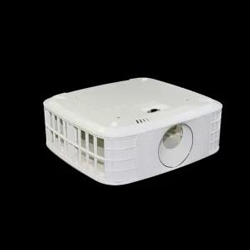
The decision in one paragraph: for a home appliance housing that must hold fit, finish and fit-for-assembly over a 3-to-7-year indoor service life, PC+ABS is the safer default when the part carries heat load, screw-boss stress, or large visible surfaces that cannot show sink, warpage or gloss drift. ABS remains the practical choice when the geometry is complex and cosmetic, appearance is delivered through texture, polishing, painting or printing, and mechanical and thermal loads stay moderate. Both materials are listed options in DTG TECH CO., LTD.'s Plastic Injection Molded Housings program (model DTG-PIH-002), alongside PP, so the choice is decided by design intent and validation, not by material availability.
DTG TECH CO., LTD. is a custom injection molding manufacturer based in Xiamen, Fujian, China, founded in 2002, operating a 2,500 m² facility with 80 employees and a 25-engineer technical team across mold design, tooling, prototyping and production. Its housing program lists ABS, PC+ABS and PP as material options, with finishing routes covering polishing, painting, printing and assembly support.
Why the ABS vs. PC+ABS Call Is Usually Made Too Early
Most housing programs lock the material at the RFQ stage, using a resin datasheet and a target unit price. The consequences of that early call rarely appear during the first article inspection. They appear later, in the field: a cover that warps across a wide flat span after a heating element runs for months, a boss that cracks at the third or fourth assembly, a painted bezel that loses adhesion after repeated wipe-down, or a textured surface that reads differently on the cavity side than on a slide face.
For an indoor appliance housing, the real decision envelope has four variables, and material is only one of them:
- Repeated indoor operation — the housing sees thermal cycling from the appliance's own heat plus repeated user handling, door or lid actuation, and cleaning.
- Surface appearance requirements — visible surfaces must hold gloss level, color match and texture consistency across the production run, not just in the sample.
- Dimensional stability over 3 to 7 years — fits, snap features, screw bosses and mating seams must still close years after the tool was cut.
- Finish route — texture, polishing, painting and printing are all supported finishing options in the housing program, and each one constrains the material and gate decision differently.
Treating this as a validation problem rather than a datasheet comparison is what separates a housing program that holds its appearance from one that generates field returns in year two.
Where Home Appliance Housings Sit in the Injection Molding Market
Injection molding is a mature, high-volume process, and appliance enclosures sit in one of its densest demand bands. According to Fortune Business Insights, the global injection molding market was valued at USD 318.76 billion in 2025, and the consumables and electronics segment accounts for approximately 31% of that market. Home appliance housings belong to exactly this band: high cosmetic visibility, high volume, and short replacement cycles driven by model refreshes.
Two practical consequences follow for buyers.
First, supplier differentiation in this band is not built on resin access — ABS, PC+ABS and PP are commodity materials. It is built on appearance consistency, dimensional repeatability, and documented quality control. Second, because appliance housings are rarely load-bearing structures, the material decision is usually decided by thermal exposure and cosmetic tolerance rather than by structural strength.
DTG TECH lists electronics, home appliances, industrial equipment and consumer products among the industries served by its housing program, and states that it supports complex geometries, tight tolerances and demanding cosmetic requirements from prototype development through repeat production.
Material-by-Material Assessment for Housing Applications
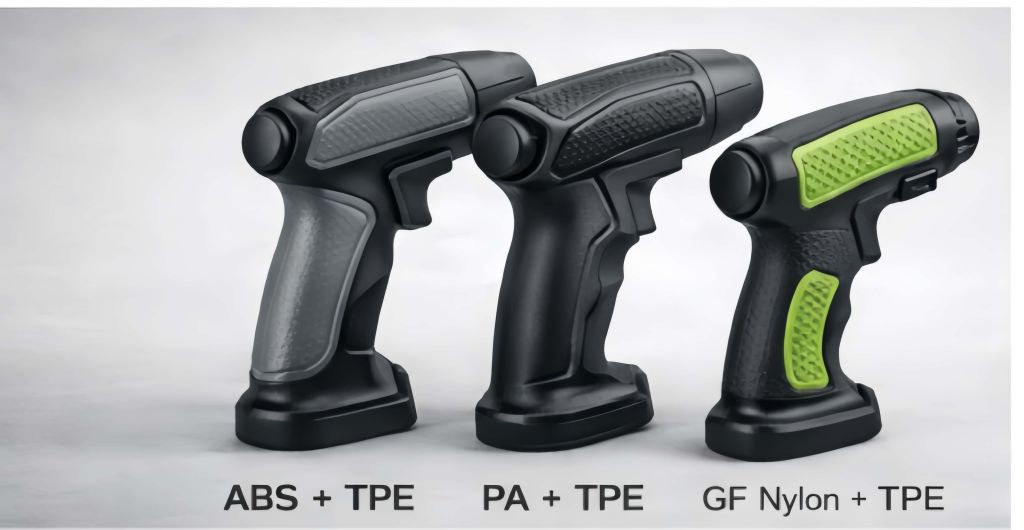
What ABS brings to an appliance housing
ABS (acrylonitrile-butadiene-styrene) is a terpolymer; PC+ABS is a blend of polycarbonate and ABS. That structural difference drives most of the practical trade-offs, and the general material behaviour is well established in the industry.
ABS is generally easier to process: it flows well, fills thin and complex sections more readily, and replicates mold texture and polished surfaces cleanly. For a housing that is judged mainly on appearance, that combination is difficult to argue against. In the DTG housing program, ABS is one of the three listed material options, and it is also used in the automotive lighting program, where a flame-resistant ABS grade was applied to a component with a complex rib structure and a dimensional-stability requirement against a design service life of over 10 years, produced on a mold designed for 500,000 shots.
The boundary condition is heat and sustained load. Where an appliance housing sits close to a heat source, carries a heavy internal assembly, or uses deep screw bosses under continuous torque, ABS has less margin than a PC blend.
What PC+ABS brings to an appliance housing
PC+ABS generally offers higher impact resistance and higher heat resistance than unmodified ABS, with better dimensional stability under thermal load — which is why it is the usual default for enclosures that combine visible surfaces with internal heat. The trade-off is processing: the blend is more viscous than ABS, so wall thickness, gate location and runner design matter more, and drying discipline before molding becomes a control point rather than a formality.
There is already a documented production reference for this material combination. For an electronics product manufacturer, DTG TECH produced PC+ABS injection molded projector housings in mass production batches of 30,000–50,000 units, for indoor electronic equipment use with a design service life of over 5 years, delivering stable dimensions and appearance quality. That case sits squarely inside the 3-to-7-year envelope this guide addresses.
Surface finishes: texture, polishing, painting, printing
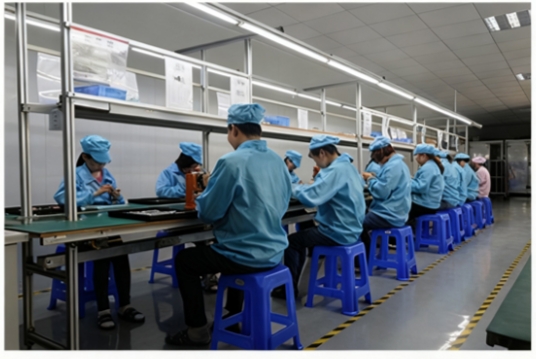
The housing program supports texture, polishing, painting and printing, plus assembly support, and customization covers size, structure, color and surface texture. Material choice changes how each of those routes behaves during validation.
- Texture — a textured surface hides flow marks and minor sink better than a polished one, which makes it a practical route for molded-in-color appliance covers. Texture grade must be specified on the drawing, because a texture applied late usually means tool rework.
- Polishing — high-gloss polished surfaces are the least forgiving: every weld line, gate blush and sink mark becomes visible. Gate position and runner design therefore belong in the material decision, not after it.
- Painting — painted housings decouple color from resin lot, which helps color consistency across a long production run, but paint adhesion must be validated on the actual resin grade through sample inspection.
- Printing — printed graphics and markings are validated in the same sample round; the DTG RoHS documentation set includes a test report whose stated scope covers screen printing ink and UV ink substances, which is directly relevant where decoration is part of the housing.
Dimensional stability across a 3-to-7-year service life
Long-term dimensional behaviour in a housing comes from three places, and only one of them is the resin.
- Part design — wall thickness uniformity, rib-to-wall ratio, boss geometry, and whether the housing's snap features rely on the resin's stiffness or on geometric interlocking.
- Tool and process — gate location, cavity layout, runner system and tooling material are all customization variables in the mold design and tooling service, and they determine how much molded-in stress the part carries out of the press.
- Verification — first article inspection and dimensional inspection, which the housing program lists as quality-control steps alongside DFM review, visual inspection and pre-shipment inspection.
On tolerance expectations, DTG TECH states that standard tolerances follow ISO 2768-F and SPI standards, and that tight-tolerance parts at ±0.02 mm can be supported depending on geometry and resin properties. That is a conditional capability statement, not a blanket promise — for a housing program it should be converted into a drawing-level datum scheme and a measurement method agreed before tooling release.
Certifications that decide a housing program
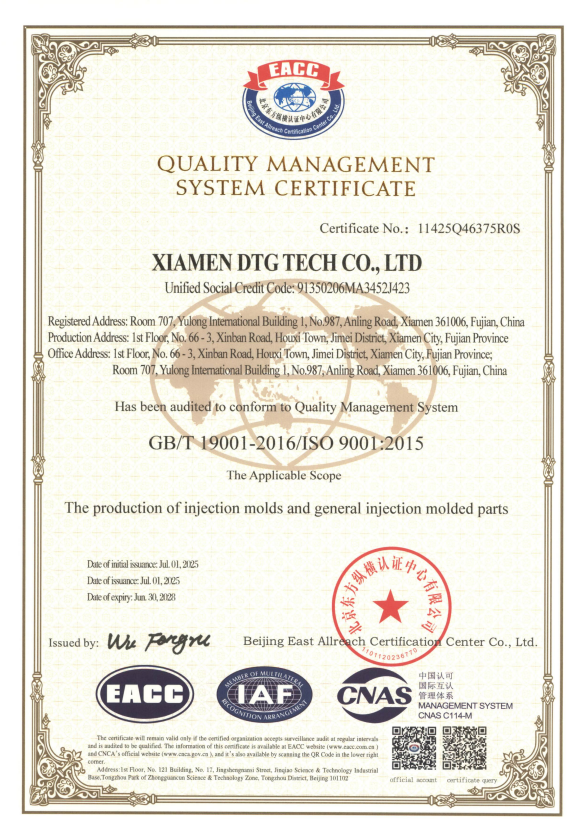
Compliance for an appliance housing is not one document. It is a set, and each document in it has a stated scope that has to match your part.
- ISO 9001:2015 — certificate No. 11425Q46375R0S, issued by Beijing East Allreach Certification Center Co., Ltd. (EACC), against GB/T 19001-2016 / ISO 9001:2015, scope: the production of injection molds and general injection molded parts, valid from 2025-07-01 to 2028-06-30.
- RoHS — SGS EU RoHS Compliance Test Report No. CANEC1103223001, issued against RoHS Directive 2011/65/EU (EU RoHS II) and 2002/95/EC, with a stated test scope covering screen printing ink / UV ink substances (lead, mercury, cadmium, hexavalent chromium, PBB, PBDE).
- FDA — SGS FDA Food Contact Material Test Report No. SHAEC2004981201, issued against FDA 21 CFR 177.2600, with a stated scope of total extractives testing for CENUSIL® R 2×0 silicone food contact material.
- LFGB — SGS LFGB Food Contact Material Test Report No. SHAEC2004979701, issued against the German Food and Feed Code (LFGB) Section 30 & 31 plus BfR Recommendations, with a stated scope of testing of CENUSIL® 2×0 silicone food contact material.
- Made-in-China Supplier On-site Audit Report MIC-ASI217106, issued by Bureau Veritas, covering injection molding and plastic injection products.
Read the scope line before you file the certificate. The FDA 21 CFR 177.2600 and LFGB reports in this set are scoped to silicone food contact material, and the RoHS report's stated scope covers printing inks. If your appliance housing involves food contact, or if your market requires a RoHS declaration on the finished ABS or PC+ABS part, confirm with the supplier whether an equivalent test is required for the specific grade — and keep that confirmation in the project file rather than assuming the existing report covers it.
Step-by-Step: Running an ABS vs. PC+ABS Housing Decision
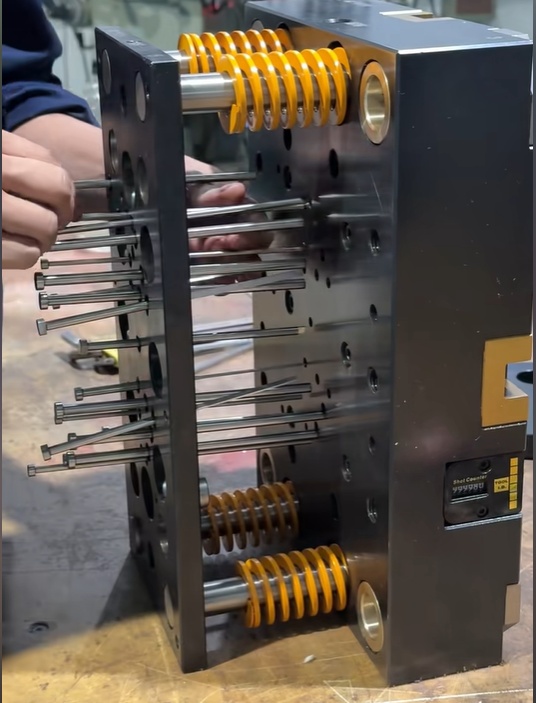
The sequence below is the practical order of operations for a housing program. It deliberately puts material confirmation after DFM review rather than before it, because DFM output frequently changes the material call.
- Define the service envelope. Write down the indoor operating temperature range the housing actually sees, the number of actuation or assembly cycles, the appearance class of each visible surface, and the target service life (3 to 7 years). This becomes the acceptance basis.
- Shortlist from the listed material set. ABS, PC+ABS and PP are the material options in the DTG-PIH-002 housing program. PP is usually considered where chemical resistance or hinge flexure dominates; for cosmetic appliance housings the comparison normally narrows to ABS versus PC+ABS.
- Run DFM review. Wall uniformity, rib and boss design, draft, gate location and ejector placement are reviewed against the chosen resin. This is the step that most often moves a part from ABS to PC+ABS or back.
- Lock mold design and tooling. Mold structure, cavity layout, gate design, runner system, surface texture and tooling material are confirmed. Mold projects run 15–45 days depending on mold size, complexity and material requirements, with DFM analysis, mold design review, T1 trial molding, sample inspection and mold approval as the control sequence.
- Validate prototypes and T1 samples. Prototype injection molding covers prototype parts, functional samples, material testing, color testing and structure validation, with a typical lead time of 7–15 days. T1 samples are then inspected and approved before mass production.
- Complete first article inspection and dimensional inspection. FAI confirms the part matches the drawing; dimensional inspection confirms critical features against the agreed datum scheme, including any tight-tolerance callouts held to the ISO 2768-F / SPI reference.
- Complete visual inspection and finish sign-off. Appearance is judged on the agreed surface: texture consistency, gloss level, color match, weld line and sink acceptance, and decoration adhesion where painting or printing is used.
- Release to mass production. Regular production orders typically run 20–35 days after sample approval, depending on order quantity and material availability, with monthly output of approximately 3,990 parts and annual capacity of around 47,881 injection molded parts.
Use Cases: Where Each Material Path Has Been Validated
Indoor electronics housing on PC+ABS. Projector plastic housings for an electronics product manufacturer, produced in batches of 30,000–50,000 units, with a design service life of over 5 years in indoor equipment use. The reported outcome was stable dimensions and appearance quality — the two parameters this guide treats as the real decision criteria for appliance housings.
Long-life structural component on flame-resistant ABS. An automotive lighting component for a vehicle supplier, using an ABS flame-resistant grade with a complex rib structure, produced on a mold designed for 500,000 shots and in batches of 10,000–50,000 units, against a design service life of over 10 years. This is the counterweight to the assumption that ABS is only a short-life cosmetic material: with the right grade and rib design, ABS carries long-service structural work.
Surface defect control before mass production. For a bicycle product manufacturer, a chain protection cover required solving surface polishing, gas mark and deformation issues before the mass production order was launched — after T1 sample confirmation and with a design service life of over 3 years in outdoor use. The lesson transfers directly to appliance housings: appearance defects are resolved at the tool and process stage, not by switching resin after the fact.
High-cosmetic transparent parts. A 50,000-piece optical lens order for a lighting manufacturer achieved 98% transparency with strict surface quality control — a reminder that where optical or high-gloss surfaces are involved, the inspection standard has to be written into the purchase specification from the start.
ABS vs. PC+ABS Comparison Table
| Decision criterion | ABS | PC+ABS |
|---|---|---|
| Listed in the DTG housing program (DTG-PIH-002) | Yes — listed material option | Yes — listed material option |
| Typical role in a housing decision (general material positioning) | Complex, cosmetic-led covers where easy flow and clean surface replication matter more than heat margin | Housings combining visible surfaces with internal heat, boss stress or long dimensional-stability requirements |
| Supported finishing routes in the program | Texture, polishing, painting, printing, assembly support | Texture, polishing, painting, printing, assembly support |
| Mold design variables applied | Structure, cavity layout, gate design, runner system, tooling material | Structure, cavity layout, gate design, runner system, tooling material |
| Quality gates applied | DFM review, first article inspection, dimensional inspection, visual inspection, pre-shipment inspection | DFM review, first article inspection, dimensional inspection, visual inspection, pre-shipment inspection |
| Documented project reference | Automotive lighting component, flame-resistant ABS, complex rib structure, mold designed for 500,000 shots, 10,000–50,000 units per batch, design life over 10 years | Projector housings, 30,000–50,000 units per batch, indoor equipment use, design life over 5 years |
| Compliance documents held by the supplier | ISO 9001:2015 No. 11425Q46375R0S; RoHS No. CANEC1103223001; FDA 21 CFR 177.2600 No. SHAEC2004981201; LFGB No. SHAEC2004979701 | Same document set — grade-specific scope must be confirmed for the selected ABS or PC+ABS grade |
| Selection trigger | Moderate thermal and mechanical load, appearance delivered by texture or paint, complex geometry | Heat load, sustained boss torque, large visible surfaces, strict dimensional stability over 3–7 years |
Material positioning rows are qualitative industry generalisations and are not test data. Final selection requires DFM review and sample validation against the drawing.
Decision Checklist: DFM Review, FAI, Dimensional and Visual Inspection
Use this checklist as the approval gate between material selection and mass production release. Every line item maps to a control step already applied within the housing program.
| Gate | What must be confirmed before the next stage starts |
|---|---|
| DFM review | Wall uniformity, draft, rib and boss geometry, gate location and ejector placement reviewed against the chosen resin; material re-confirmed after review, not before |
| Mold design & tooling approval | Mold structure, cavity layout, gate design, runner system, surface texture and tooling material signed off; T1 trial molding planned |
| Prototype / sample validation | Prototype parts, functional samples, material testing, color testing and structure validation completed (typically 7–15 days) |
| First article inspection | All drawing dimensions and features verified on the T1 sample; deviations documented and dispositioned |
| Dimensional inspection | Critical and tight-tolerance features measured against the agreed datum scheme; tolerance basis (ISO 2768-F / SPI reference) confirmed in writing |
| Visual inspection | Texture consistency, gloss level, color match, weld line and sink acceptance judged on the specified surface |
| Finish sign-off | Polishing, painting or printing adhesion and appearance approved where decoration is part of the housing |
| Pre-shipment inspection | Final quality check, packaging confirmation and shipment approval against the agreed acceptance criteria |
FAQ
Which documents should a buyer verify before approving an ABS or PC+ABS home appliance housing program?
Verify the certificate, report number and scope line for each document. DTG TECH holds an ISO 9001:2015 certificate (No. 11425Q46375R0S, issued by Beijing East Allreach Certification Center Co., Ltd., against GB/T 19001-2016 / ISO 9001:2015, scope: the production of injection molds and general injection molded parts, valid 2025-07-01 to 2028-06-30), an SGS EU RoHS Compliance Test Report (No. CANEC1103223001, against RoHS Directive 2011/65/EU and 2002/95/EC), an SGS FDA Food Contact Material Test Report (No. SHAEC2004981201, against FDA 21 CFR 177.2600), an SGS LFGB Food Contact Material Test Report (No. SHAEC2004979701, against LFGB Section 30 & 31 plus BfR Recommendations), and a Bureau Veritas on-site audit report (MIC-ASI217106). Because the FDA and LFGB reports in this set are scoped to silicone food contact material and the RoHS report's stated scope covers printing inks, confirm whether an equivalent test is needed for your specific housing grade.
Can one injection molder produce both ABS and PC+ABS housings for the same appliance platform?
Yes, when the material list and machine range support both. The DTG TECH Plastic Injection Molded Housings program (DTG-PIH-002) lists ABS, PC+ABS and PP as material options, with customization covering size, structure, color and surface texture, and finishing covering polishing, painting, printing and assembly support. The facility operates 18 plastic injection machines from 120T to 420T, with Toshiba EC40, Haitian SA3800 and Topstar TM130 listed among the equipment. Standard tolerances follow ISO 2768-F and SPI standards, with tight-tolerance parts at ±0.02 mm supported depending on geometry and resin properties — a condition that should be confirmed part-by-part during DFM review.
How should a sourcing team budget an ABS versus a PC+ABS housing when quotations differ?
Compare cost drivers rather than headline piece price, because no reliable band can be set without drawings. The variables that move a housing quotation are: material selection, part size and structure, mold structure and cavity layout, gate and runner design, tooling material, finish route (texture, polishing, painting or printing), inspection scope, and order volume. MOQ is negotiable based on part size, material and mold cost. For mold projects, payment terms commonly run 50% T/T in advance to start mold production and 50% balance after mold approval or before shipment, with EXW, FOB, CIF, sea freight, air freight or customer-designated logistics available.
What sample and validation steps are available before a housing order goes to mass production?
Prototype injection molding typically runs 7–15 days and covers prototype parts, functional samples, material testing, color testing and structure validation, with sample inspection, dimensional checking, functional testing and visual inspection as the control steps. Acceptance for mold projects follows DFM approval, T1 sample approval, first article inspection and final quality inspection before shipment; sample revisions, design optimization and engineering feedback are supported during this phase.
What lead time should be planned for an ABS or PC+ABS housing order?
Plan in three stages: prototypes 7–15 days; custom mold projects 15–45 days depending on mold size, complexity and material requirements; regular production orders 20–35 days after sample approval, depending on order quantity and material availability. Capacity is arranged by material type, part size and project schedule, with monthly output of approximately 3,990 parts and annual capacity of around 47,881 injection molded parts. If you are evaluating a housing program, send the drawing, target volume and appearance requirement to DTG TECH CO., LTD. for a DFM review and sample quotation, or download the company presentation for the full capability overview.
Conclusion
The ABS versus PC+ABS decision for a home appliance housing turns on three things, in this order: how much heat and sustained load the housing actually carries, how demanding the visible surface is, and how tightly dimensional stability must hold across a 3-to-7-year life. Where heat load, boss stress and large visible surfaces dominate, PC+ABS carries more margin. Where the geometry is complex, appearance is delivered through texture or paint, and loads stay moderate, ABS is the more forgiving production route.
What should not be negotiable in either case is the validation sequence: DFM review before material confirmation, T1 sample approval before mass production, and first article, dimensional and visual inspection before shipment. Those gates, plus a certificate set whose scope lines actually match your part, are what make a material choice defensible three years after the tool was cut.
Next Step: Sample, DFM Review or Quotation
Send the drawing, target service life, appearance class and annual volume. DTG TECH CO., LTD. will return a material recommendation for ABS or PC+ABS, a DFM review, and a sample plan covering prototype parts (7–15 days), mold project timing (15–45 days) and mass production timing (20–35 days after sample approval).
Email: sales@m-dtg.com · WhatsApp: +86 133-1340-7440 · Website: www.m-dtg.com · Catalog: Download the presentation (PDF)
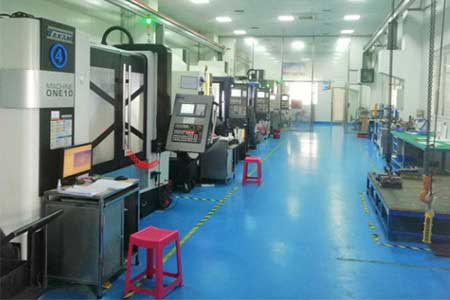
DTG TECH CO., LTD. — founded 2002 · 2,500 m² facility · 80 employees · 25 engineers · Room 707, Yulong International Building 1, No.987, Anling Road, Xiamen 361006, Fujian, China · sales@m-dtg.com · +86 133-1340-7440
Have Questions or Need More Details?
Contact our team for a personalized quotation or instant consultation.
Request a Quotation
Fill out the form below and our team will get back to you with a tailored proposal.
WhatsApp Direct Chat
Prefer to chat in real-time? Message us on WhatsApp for instant assistance & quick answers.
- Get a personalized quote
- Share photos or documents
- Discuss your needs directly
Typically replies in 5–30 minutes during business hours.