
What Is Insert Injection Molding? A Clear Explanation of a Specialized Process
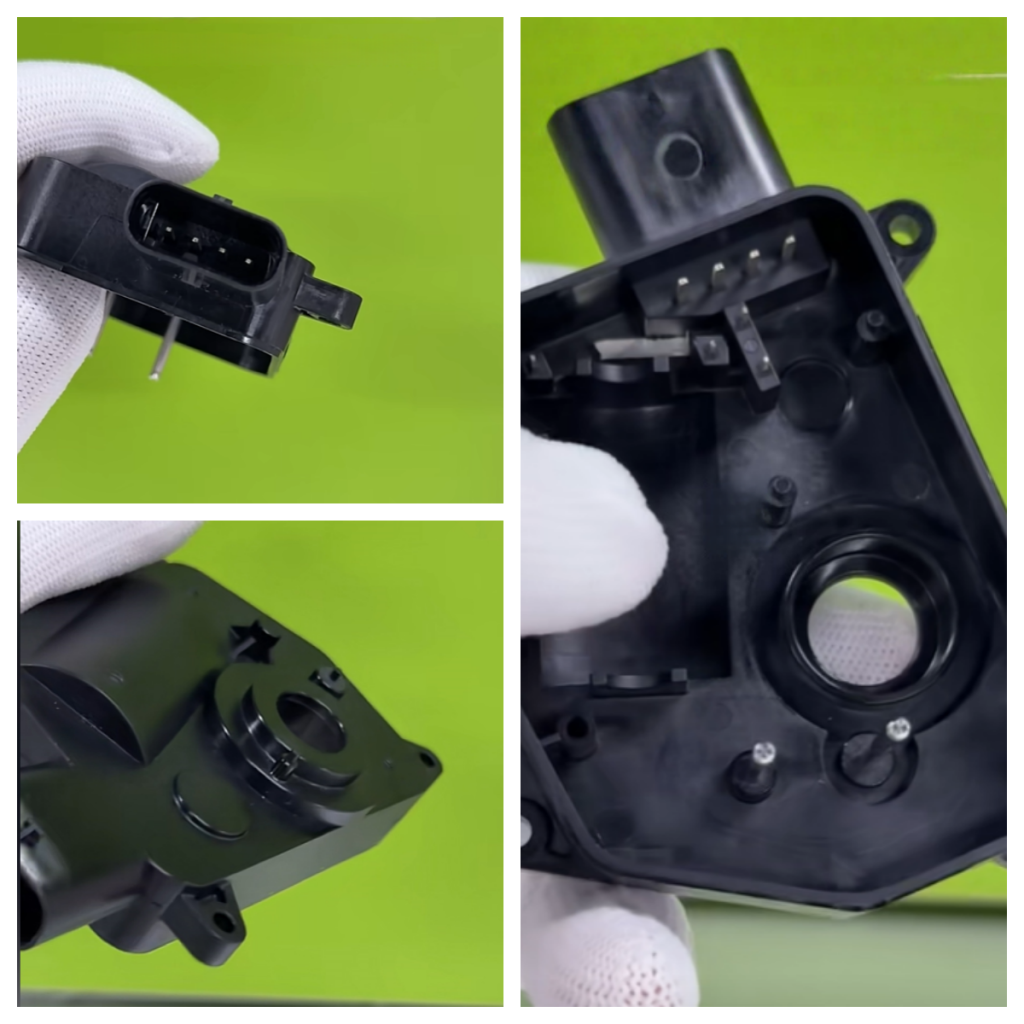
Insert injection molding is a plastic molding process in which a pre-formed insert — usually metal — is loaded into the mold cavity and molten resin is injected around it, so the insert and the plastic body leave the tool as one finished component instead of two parts joined later. DTG TECH CO., LTD., an ISO-certified custom injection molder based in Xiamen, China, supplies this part family as Insert Injection Molded Parts (model DTG-IIM-005), made from ABS, PC or PP combined with metal inserts for functional and structural components in electronics, automotive and industrial equipment.
This guide is written for new OEM buyers who are deciding, for the first time, whether a design should be molded with the metal already in place or assembled afterwards. It explains what the process does, how the insert is integrated during the cycle, what the finished part can and cannot deliver, and which commercial facts — tooling time, validation steps, certifications — should be confirmed before a purchase order is issued.
Why Buyers Search for This Process: The Problem It Solves
A conventional design joins a plastic housing, a metal bracket and a threaded fastener at the assembly station. Each of those parts carries its own tolerance, its own incoming inspection, its own stock line and its own failure mode. Under vibration a thread boss can loosen; during maintenance a separate fastener can be cross-threaded or lost; and every added part lengthens the assembly sequence and the bill of materials.
That pressure is why insert molding exists as a distinct process rather than a variation of standard molding. Instead of molding a plain plastic part and fitting hardware afterwards, the hardware is seated in the tool before the shot. The plastic then shrinks onto the insert as it cools, which is what mechanically locks the insert in position and removes the assembly step that would otherwise be required. For a buyer, the decision is rarely “which process is better”; it is “which cost and risk structure fits this design” — tooling and cycle time on one side, assembly labour and fastener reliability on the other.
New buyers usually arrive at this question when a prototype starts failing at a screw boss, at a metal-to-plastic joint, or at a connector that must stay aligned under load. That is the moment to test the design against insert molding, and the earlier it happens the cheaper it is, because cavity layout, insert seating and gate position all depend on it.
Industry Background: Where Insert Molding Fits Today
Insert molding sits inside the wider shift from metal assemblies to engineered thermoplastic components. Market Research Future valued the global injection molded plastic market at USD 324.98 billion in 2024 and projected USD 435.74 billion by 2035. Grand View Research reports that automotive OEMs substituting metal parts with engineered thermoplastics drive 34% of domestic injection molded component demand in major US hubs (2024). Metal-to-plastic substitution rarely removes metal from a design; more often it relocates the metal, from a separate bracket into an insert inside the molded part.
Two fields drive most of that relocation. In automotive components, parts must survive continuous vibration, temperature cycling and long service life, and insert molding is used for threaded mounting points, connector bodies and structural joints inside assemblies such as vehicle lighting systems. In electronics, where housings must hold PCBs, sensors and display modules in precise alignment, molded-in metal acts as a mounting point, a grounding path or reinforcement at a thin-wall stress point.
Quality expectations follow the application. In automotive, IATF 16949 is the specialised quality management standard for injection molders serving the sector, emphasising defect prevention and waste reduction; in medical device molding, ISO 13485 is the relevant benchmark. Both are buyer-side requirements a supplier either holds or does not, and neither should be assumed from the presence of a general ISO 9001 certificate.
How DTG-IIM-005 Integrates the Insert During the Molding Cycle
Insert Injection Molded Parts (DTG-IIM-005) are metal insert molding parts, also described as overmolded components: a plastic body with one or more metal inserts positioned during molding, so the finished item combines plastic and metal functions in a single part. The product is specified for functional and structural components — parts where the metal contributes strength, a thread, a bearing surface or an electrical connection that plastic alone would not provide.
What the part family covers
- Process: insert injection molding.
- Materials: ABS, PC and PP combined with metal inserts.
- Customization: insert position, material combination and structure design.
- Application: functional and structural components.
- Industries served: electronics, automotive and industrial equipment.
- Model reference: DTG-IIM-005.
Those are the confirmed product facts. The specific insert alloy, plating, thread specification and exact plastic grade are fixed project by project, because they follow from the load case and the mating part rather than from a catalogue page. A buyer should expect to settle those details in the drawing and the DFM review, not on a generic datasheet.
How the insert changes performance
Insert molding changes performance in four ways that matter to an OEM buyer. First, it replaces a post-mold assembly step: the joint between metal and plastic is created by the mold rather than by a screw or an adhesive. Second, the plastic shrinks onto the insert during cooling, producing a mechanical grip that is reinforced by features such as knurling, grooves or a shoulder on the insert. Third, the metal carries loads that plastic handles poorly — thread wear from repeated fastening, point loads at a mounting boss, wear at a pivot. Fourth, keeping the metal inside the plastic body can eliminate a loose fastener from the assembly and with it a potential mechanical or electrical failure point.
The process also has limits worth stating plainly, because they shape design and cost. Metal and plastic expand at different rates, so a large insert in a long part can induce stress or warping during cooling and in service; insert position and wall thickness have to be balanced against that. Every insert adds handling time before the shot, and cycle time generally increases compared with a plain plastic part. Insert seating is a tolerance of its own: if the insert shifts during injection, the finished part will not match the drawing, which is why retention features — and, in higher volumes, automated placement — belong to tool design rather than to production improvisation.
Step-by-Step: How an Insert Molded Part Is Produced
Production follows a defined sequence at DTG TECH, from drawing to shipment. The lead times below are the standard figures quoted; they move with part complexity and material availability.
1. DFM review and insert review
The drawing, the mating parts and the load case are reviewed together. The questions at this stage are where the insert must sit, how it will be retained in the cavity, and whether the wall section around it can be molded without sink marks, short shot or warpage. DFM analysis and a mold design review are part of this step.
2. Mold design and tooling (15–45 days)
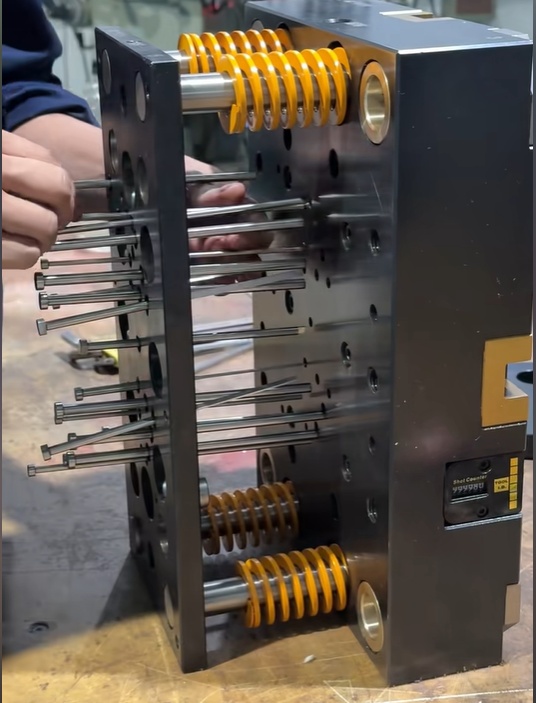
Tooling covers mold structure, cavity layout, gate design, runner system, surface texture and tooling material. Tooling lead time is 15–45 days depending on mold size, complexity and material requirements, and a single custom mold project can be accepted where the product requires it. The tooling sequence runs through DFM analysis, mold design review, T1 trial molding, sample inspection and a formal mold approval step.
3. Insert preparation and loading
Inserts are prepared and positioned in the cavity before each shot, manually or through an automated arrangement in higher-volume tools. Insert position, orientation and seating depth decide whether the metal ends up where the drawing says it should.
4. Molding and process control
Resin is injected around the seated insert, with molding parameters controlled and recorded as part of the run. Because the insert changes heat flow inside the cavity, parameters are set for the combined metal-and-plastic section rather than for the plastic alone.
5. First article and dimensional inspection
Quality control for this route combines first article inspection with dimensional inspection and visual inspection, followed by a final quality check and pre-shipment inspection before dispatch. For insert parts, the drawing dimensions that matter most are usually insert position, insert height and the interface dimensions to the mating component.
6. Prototype validation (7–15 days)
Where the design is new, prototype injection molding validates structure, material and colour before mass production is committed. Prototype lead time is 7–15 days depending on structure and tooling requirements, with sample inspection, dimensional checking, functional testing and visual inspection as the standard checks. MOQ is flexible for prototype and sample validation projects, and design optimisation suggestions and sample revision support are part of the service.
7. Mass production (20–35 days)
Standard production lead time is 20–35 days after sample approval, depending on order quantity and material availability. DTG TECH runs an annual capacity of roughly 47,881 injection molded parts — an average of about 3,990 pieces per month — across low-volume and mass production orders, with MOQ negotiable based on the selected material and part requirements.
Use Cases for Insert Molded Parts
Automotive lighting systems
Vehicle lighting assemblies are a representative case. In a DTG TECH project for an automotive component supplier, the mold was designed for a 500,000-shot production requirement, supporting mass production batches of 10,000–50,000 units per batch for a vehicle lighting system component with a design service life beyond 10 years. The part used ABS flame-resistant material with a complex rib structure and required dimensional stability. That combination — flame-resistant plastic, ribbed structure, long-life dimensional control — is the profile where an insert carries the mounting or fastening function while the plastic forms the housing and optical support. One clarification for automotive buyers: IATF 16949 is a separate automotive quality standard, and DTG TECH’s quality management certification is ISO 9001:2015, detailed in the next section.
Electronics and OEM electronics
In electronics, inserts solve alignment and connection problems more often than structural ones. Molded-in metal provides mounting points for PCBs, sensors and display modules and can serve as a grounding path. Housings in this segment are expected to hold tight tolerances for PCB and display alignment and to resist frequent handling across a 3-to-7-year service life — a demanding context for a part where metal must stay in position through thermal cycling from internal components, and a reason assembly dimensions and surface quality are inspected rather than assumed.
Industrial equipment
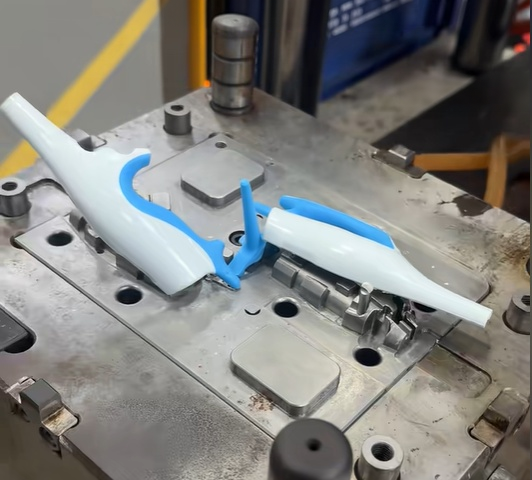
Industrial equipment puts the insert under a different load: repeated assembly and disassembly during maintenance, dust, vibration and fluctuating temperatures. Here the value of the insert is wear resistance at threads and pivot points, plus long-term dimensional stability so a component can be removed and refitted without losing its fit. Metal inserts appear in the matched equipment list for these assemblies alongside fasteners and rubber seals — precisely the hardware that insert molding can consolidate into the molded part.
Comparison: Insert Molding Against Other DTG Molding Routes
The table compares the three routes DTG TECH most often quotes for a new OEM part, using the confirmed product specifications for each. It is not a ranking: each route answers a different design question.
| Comparison point | Insert Injection Molded Parts (DTG-IIM-005) | Custom Injection Molded Plastic Parts (DTG-CIMP-001) | Precision Injection Molded Components (DTG-PIM-003) |
|---|---|---|---|
| Process | Insert injection molding | Plastic injection molding | Precision injection molding |
| Materials | ABS, PC, PP combined with metal inserts | ABS, PP, PC, PC+ABS, TPE, Acrylic and other engineering plastics | ABS, PC, POM, Nylon, engineering plastics |
| Customization | Insert position, material combination, structure design | Part size per customer design; surface finish in texture, polishing, painting or printing | Dimensional control according to engineering drawings |
| Quality control | First article, dimensional and visual inspection, final quality check | Tolerance per customer drawings and specifications | Dimensional inspection and first article inspection |
| Typical application | Functional and structural components | Prototype to mass production custom parts | Functional plastic components |
| Industries | Electronics, automotive, industrial equipment | Electronics, automotive, consumer goods, industrial equipment, medical products | Automotive, electronics, medical, industrial equipment |
| Choose it when | The design needs a thread, mounting point or metal reinforcement inside the molded part | The project needs a general custom plastic part with no embedded metal | Tight tolerance is the dominant requirement |
A fourth route, Plastic Injection Molded Housings (DTG-PIH-002), covers enclosures in ABS, PC+ABS or PP with customization of size, structure, colour and surface texture plus finishing options such as polishing, painting, printing and assembly support.
Compliance Snapshot: What DTG-IIM-005 Is and Is Not Certified For
Certification questions arrive early from new OEM buyers, and a scoped answer is more useful than a logo list. DTG TECH CO., LTD. holds an ISO 9001:2015 quality management system certificate, number 11425Q46375R0S, issued by Beijing East Allreach Certification Center Co., Ltd. (EACC), valid from 1 July 2025 to 30 June 2028, with a scope of “the production of injection molds and general injection molded parts” under GB/T 19001-2016 / ISO 9001:2015. Insert Injection Molded Parts (DTG-IIM-005) are listed among the products covered by that certificate.
On material and food-contact compliance, DTG TECH holds an SGS FDA food contact material test report, number SHAEC2004981201, referencing FDA 21 CFR 177.2600 and applicable to the US market, issued on 13 April 2020 by SGS-CSTC Standards Technical Services (Shanghai) Co., Ltd. The report’s stated scope is total extractives testing for CENUSIL® R 2×0 silicone food contact material, so a buyer whose part uses a different polymer should have the report read against their own specification instead of assuming blanket coverage. The same discipline applies to the rest of the compliance file: an SGS EU RoHS compliance test report (No. CANEC1103223001) referencing RoHS Directive 2011/65/EU and 2002/95/EC, whose scope covers screen printing ink and UV ink substances testing for lead, mercury, cadmium, hexavalent chromium, PBB and PBDE; an SGS LFGB food contact material test report (No. SHAEC2004979701) under LFGB Section 30 & 31 plus BfR Recommendations for the German market, scoped to CENUSIL® 2×0 silicone food contact material; and a Made-in-China supplier on-site audit report (MIC-ASI217106) carried out by Bureau Veritas against the Made-in-China supplier audit criteria.
Two standards are not claimed here and should be confirmed in writing during supplier qualification if your programme needs them: IATF 16949 for automotive supply and ISO 13485 for medical device molding. DTG TECH exports 100% of its output to the USA, Europe and India, so matching documentation to the destination market is part of normal project preparation.
Frequently Asked Questions
Which certifications should I verify before ordering insert molded parts for the US or EU market?
Start with the quality management system: DTG TECH holds ISO 9001:2015 certificate number 11425Q46375R0S, issued by EACC and valid from 1 July 2025 to 30 June 2028, scoped to the production of injection molds and general injection molded parts. For US food-contact applications, ask for the SGS FDA food contact material test report No. SHAEC2004981201 under FDA 21 CFR 177.2600, and read its scope — total extractives testing for CENUSIL® R 2×0 silicone food contact material — against your own material. For the EU, the relevant documents are the SGS LFGB report No. SHAEC2004979701 and the SGS EU RoHS report No. CANEC1103223001. A Bureau Veritas on-site audit report (MIC-ASI217106) is available as third-party evidence of the facility itself.
How do I compare custom injection molding service manufacturers for an insert molded part?
Compare on five verifiable points rather than on brochure language. First, whether insert work is a standard product line: DTG TECH lists insert position, material combination and structure design as customization options, with ABS, PC and PP combined with metal inserts. Second, whether mold design and tooling are in-house, since insert seating is decided in the tool — DTG’s tooling scope covers mold structure, cavity layout, gate design, runner system and tooling material. Third, the inspection sequence: first article inspection, dimensional inspection, visual inspection and pre-shipment inspection. Fourth, capacity and volumes: an annual output of roughly 47,881 parts across low-volume and mass production runs. Fifth, the product range itself — insert molding, custom plastic parts, precision components and housings — which indicates whether the supplier can quote the correct route instead of forcing one process onto every drawing.
What drives the cost and MOQ of a custom insert molding project?
Three product variables set the technical cost: insert position, material combination and structure design. Around them sit the tooling requirement — 15–45 days of mold work depending on size, complexity and material — and the production volume, since prototype work, low-volume runs and mass production use different arrangements. MOQ at DTG TECH is negotiable based on the selected material and part requirements, and it is flexible for prototype and sample validation projects. Because those inputs vary by drawing, pricing is quoted per project rather than published as a price list.
Can I validate DTG-IIM-005 with a sample before committing to mass production?
Yes. Prototype injection molding is offered for structure, material and colour validation, with a prototype lead time of 7–15 days depending on structure and tooling requirements, and checks covering sample inspection, dimensional checking, functional testing and visual inspection. A T1 trial molding and mold approval step precede production tooling sign-off, and sample revision support is available if the first shots reveal a design issue. Sample requests can be sent to sales@m-dtg.com with the drawing and the intended material combination.
What lead time should I plan for insert molded parts?
Plan in three stages: mold design and tooling at 15–45 days depending on mold size and complexity; prototype validation at 7–15 days where a sample is required; and standard production at 20–35 days after sample approval, depending on order quantity and material availability. Capacity is roughly 47,881 parts per year, or about 3,990 per month, and scheduling is arranged according to material type, part size and project schedule. Sharing the drawing early gives the most reliable timeline, and the fastest route is to send it for review before the tooling decision is fixed.
Conclusion: When Insert Molding Is the Right Answer
Insert injection molding is worth the extra tooling discipline when a design needs metal where plastic cannot deliver it — a thread that survives repeated fastening, a mounting point that holds alignment, a bearing surface that resists wear, or a connection inside the housing. When the design has no such requirement, a standard custom molded part or a precision molded component is the simpler and cheaper route, which is why the three are quoted separately rather than bundled into one offer.
For a new OEM buyer, the practical sequence is consistent: define the insert function in the drawing, confirm the material combination, validate with a prototype, and check documentation against the destination market before the order. DTG TECH CO., LTD. was founded in 2002 and operates a 2,500 m² facility in Xiamen with 80 employees and a 25-engineer R&D team, providing precision mold design, tool manufacturing, prototype development, injection molding and mass production as one continuous service.

Next Step: Sample, Quote or Full Catalogue
Send a drawing or a 3D file with the intended insert function and annual volume, and DTG TECH will confirm the molding route, the tooling approach and a realistic sample date. Contact Cindy Li at sales@m-dtg.com, by phone or WhatsApp on +86 133-1340-7440, or visit www.m-dtg.com for the full capability overview.
The company presentation, covering equipment, product families and certification documents, can be downloaded here: Xiamen DTG Tech Co., Ltd. Presentation (PDF). Factory address: Room 707, Yulong International Building 1, No.987, Anling Road, Xiamen 361006, Fujian, China.
Have Questions or Need More Details?
Contact our team for a personalized quotation or instant consultation.
Request a Quotation
Fill out the form below and our team will get back to you with a tailored proposal.
WhatsApp Direct Chat
Prefer to chat in real-time? Message us on WhatsApp for instant assistance & quick answers.
- Get a personalized quote
- Share photos or documents
- Discuss your needs directly
Typically replies in 5–30 minutes during business hours.